Every course’s materials, checked before classes start
WyderNet checks everything faculty assign against your library’s collection. Library staff see what’s ready, what needs a decision, and what’s missing. Students get one link to everything.
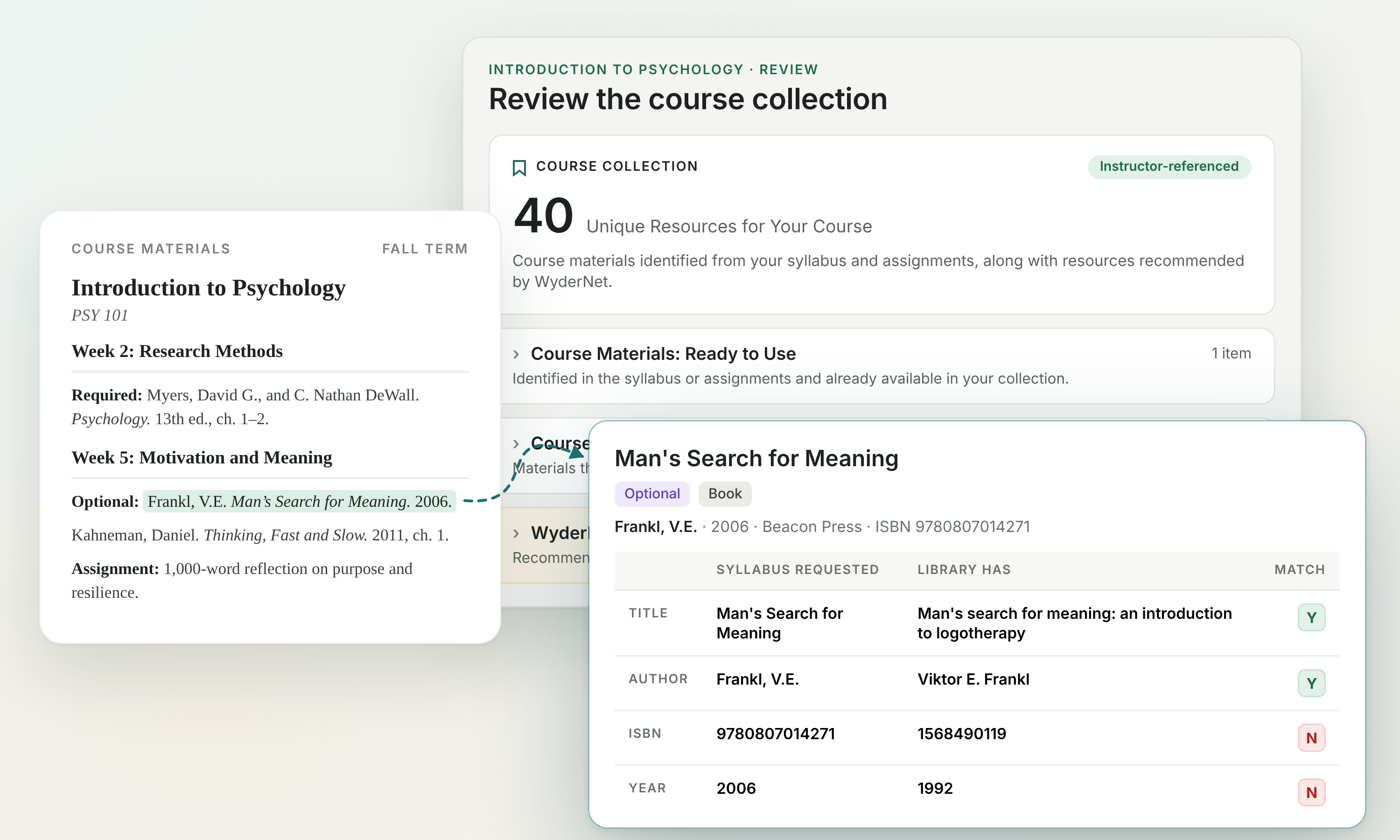
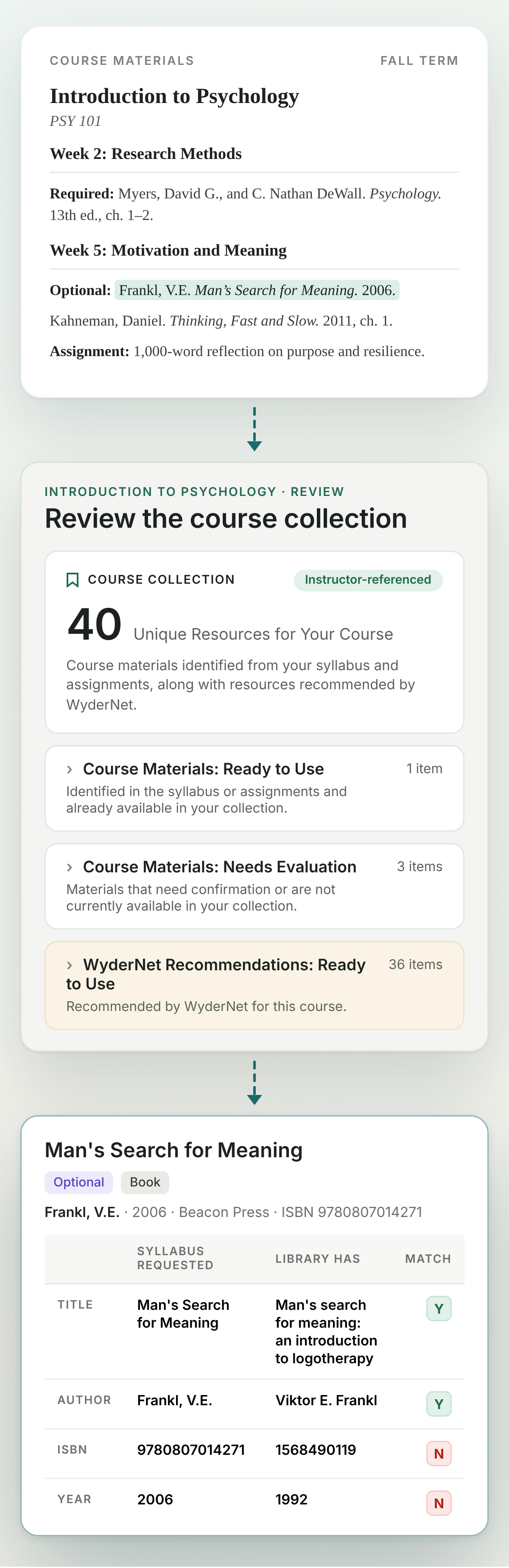
See how a course connects to your collection
WyderNet identifies assigned materials, checks them against your library’s collection, and surfaces relevant resources students can access.
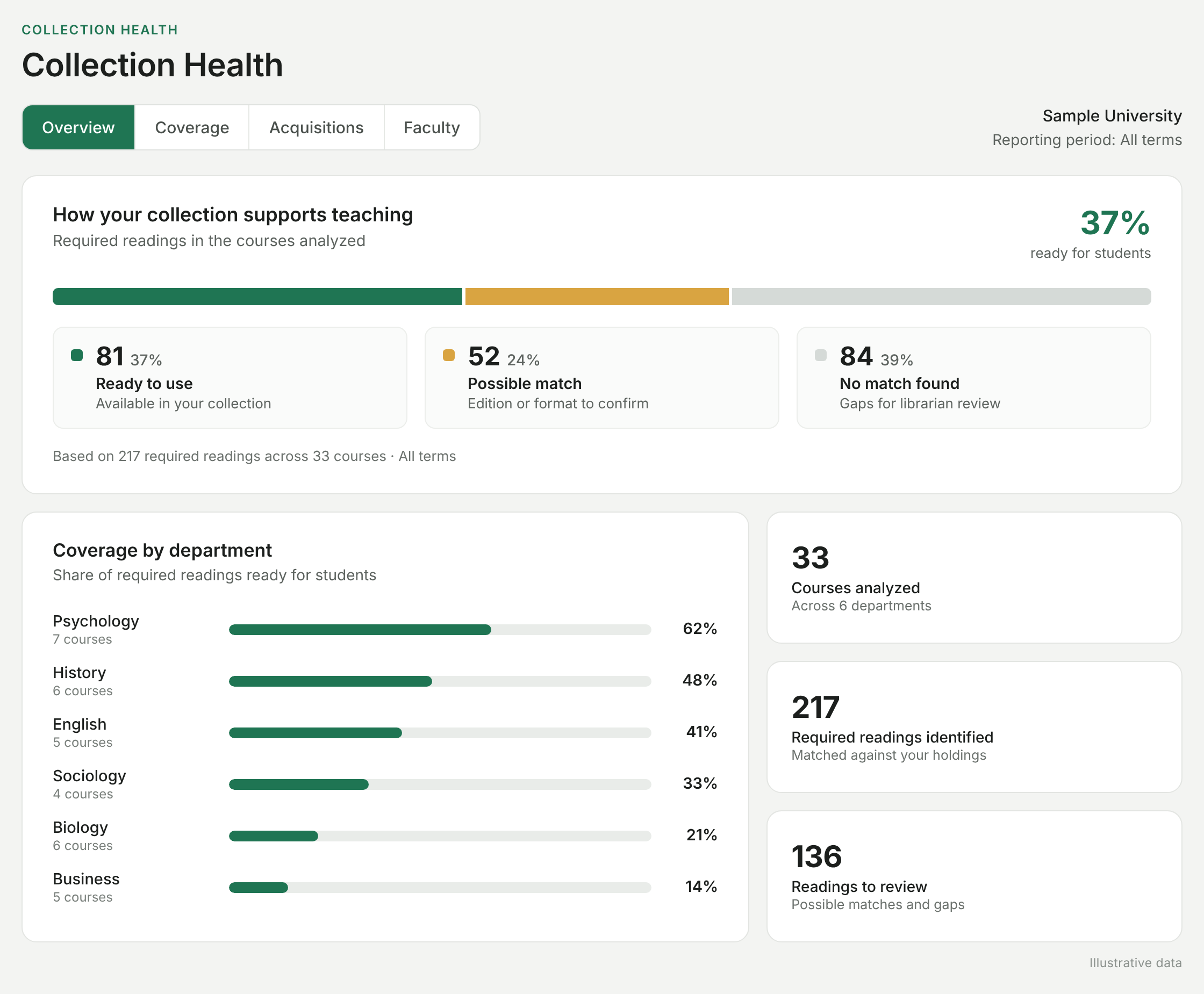
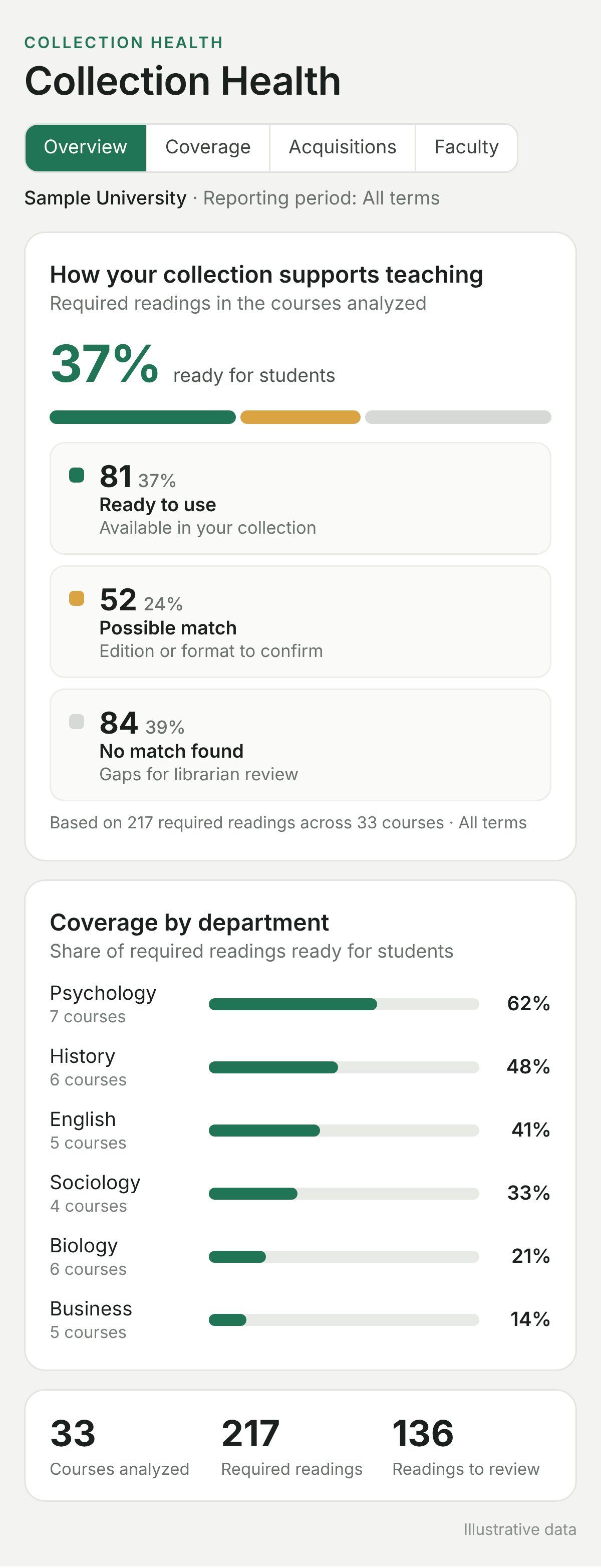
Evidence for collection development
See, department by department, how much of what's being taught students can access, and where to focus collection development.
From course materials list to course collection
Start with what you already have. WyderNet checks it against your collection, and your librarians decide what to publish.
Reads the course materials
Start with what's already available: bookstore adoption feeds, syllabi shared directly by faculty, or course materials from your LMS. WyderNet identifies the assigned materials and the topics being taught.
Checks your collection
Each title is matched to your holdings as available, missing, or needing review, with related resources from your collection alongside.
Librarians decide and publish
Your staff review gaps and access options, choose recommendations, and publish a course collection for students and faculty.
Easy to get started
✓ Use the course materials you already have
✓ No new faculty workflow
✓ Start with the courses or departments you choose
Faculty
Share a syllabus. That's it. Your students get one page with access to their assigned readings from day one.
WyderNet
Identifies assigned materials, checks them against your collection, and flags gaps and access issues.
Your librarians
Review uncertain matches and gaps, add recommendations, and decide what to make available to students.
Works with the systems you already use
WyderNet uses a read-only connection to your holdings. Nothing in your systems is changed. WyderNet checks holdings through your discovery service, fits your existing ILL and acquisitions workflows, and works alongside your reading list system and LMS.
What WyderNet does, course by course
See how assigned materials align with your collection, what students can access, and where other resources could help, with librarians in control.
Check every assigned reading
Match titles, editions, and formats to what your library holds or licenses.
Recommend beyond the reading list
Surface resources from your collection that fit the course topics. Librarians decide what to recommend.
Evaluate how to fill the gaps
See where materials aren’t available or access is limited, then choose a path (ILL, OA/OER, another format or license, or purchase) in your existing workflows.
Share with instructors
Send the course collection to the instructor, who can link it from the syllabus or LMS. Faculty review is optional.
Publish a course collection
One page with assigned readings, access links, selected recommendations, and librarian notes. Students can open the course collection without logging in. Library resources may require institutional sign-in.
Lower course material costs
See what assigned textbooks cost students, track savings when the library provides access or an OER alternative, and find resources that serve many courses.
In your collection. Nothing to do, or choose an alternative (for example, OER or an unlimited-user ebook).
A similar item is held. Confirm it’s in the catalog, or swap for another format (for example, an ebook instead of print).
Not in your collection. Pick an alternative (catalog or OER) or request a purchase.
Any item can be sent to the instructor for review. They reply from a link in the email.
Built by people who know library technology
A small team with decades in library technology, building WyderNet with design-partner libraries.

Tamir Borensztajn
Founder & Product Lead
Works with libraries to shape WyderNet, drawing on 20+ years in library technology, product, and strategy, including 11+ years at EBSCO.

Guy Shahaf
Chief Technology Officer
Builds WyderNet’s technology and leads the Library Information Systems team at Technion, drawing on 20+ years in enterprise software and cloud architecture.

Shay Gabay
Data, AI & Operations
Digs into complex questions, follows where the data leads, and evaluates our AI models to help shape WyderNet for libraries and students.
Built for the teams connecting collections to teaching
Collection development, acquisitions, electronic resources, course reserves, and instruction librarians.
Priced to start small
Start with a set of courses and expand when you see results.
$1,500/year
Core subscription includes standard setup* and onboarding, assigned-material matching, holdings checks, course collections, and Collection Health. Add courses, integrations, and services as your program grows.
*Standard setup includes supported discovery services. Additional integrations, connectors, and custom services are available separately.
How your library gets started
Start small, see the results on real courses, then decide.
1
See the workflow
Book a demo to see how WyderNet works.
2
Choose where to begin
Pick a department, program, or group of courses to start.
3
Prepare your first collections
We’ll connect WyderNet to your holdings and help your team review results and publish its first course collections.
4
Evaluate and expand
Review coverage, gaps, student access, staff time, and faculty feedback, then add courses when it makes sense.
Questions
Common questions
How is this different from our reading list or course reserves tool?
WyderNet works alongside your course reserves and reading list tools. It doesn't ask faculty to build lists. It starts from the syllabi and bookstore adoptions you already have, checks them against your collection, recommends related resources, and shows where gaps recur across courses.
Where do course materials come from?
Whatever you already have: bookstore adoption feeds, syllabi shared directly by faculty, or course materials from your LMS. LMS integration is priced separately.
What does it cost to start?
$1,500 a year for up to 25 unique courses, including standard setup and onboarding.
See pricingCan WyderNet show cost savings for students?
Yes. WyderNet shows what assigned textbooks cost students, tracks the savings when the library provides access or an OER alternative, and shows which resources serve many courses.
Can WyderNet help confirm a course is truly no-cost or low-cost?
Yes. Confirming a course is no-cost usually means checking every assigned item, not just the textbook. WyderNet checks everything assigned, including chapters and articles, against your collection, and shows what students can already access and what’s left to source.
See how WyderNet connects what's being taught to the library collection.
Book a demo to see how WyderNet connects course materials to library collections, shows what students can access, and builds a view of collection health across courses.
Book a demo
Tell us about your library and we’ll set up a demo.
Thank you.
We’ll be in touch shortly to schedule your WyderNet demo.